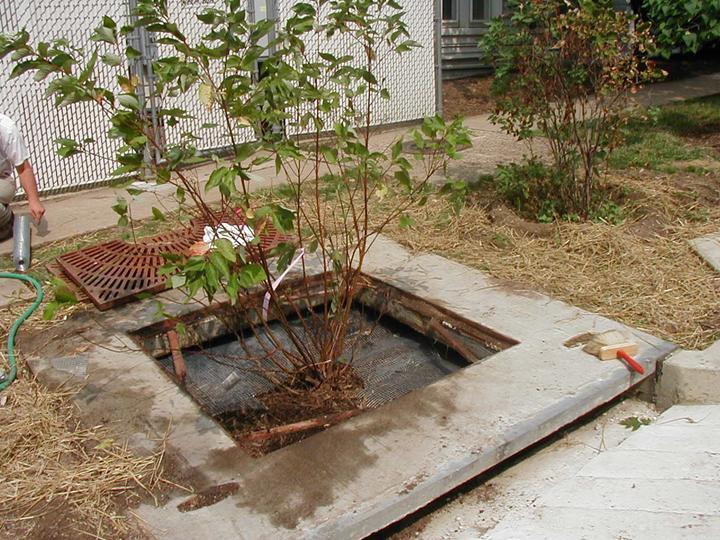
Tree box
filters should be designed (sizing, spacing, installation and location) in
accordance with manufacturer's specifications. The designer is responsible
for selecting and providing the appropriate site design parameters for a
particular design to the manufacture to ensure proper application of the
device.
Example of a completed tree box filter (Source: Americast, Inc.)
Soils Investigation
When
tree box filters
is being used to infiltrate treated runoff
into the surrounding subsoil refer to the local
jurisdiction’s requirements for soil studies and infiltration design
criteria. It is recommended that there be one soil boring log for each
structure. A gravel storage area under the tree box filter can be sized to
meet local infiltration volumes and soil infiltration rates.
Site Conditions
A
tree box filter with its enclosed non-permeable concrete container makes it
ideal for situations where infiltration is undesirable or not possible.
These situations would include: clay soils, karst topography, high
groundwater conditions, close proximity to buildings, steep slopes,
contaminated soils, brownfields sites, highly contaminated runoff,
maintenance facilities and gas stations. For “hot spots” where chemical
spills are likely, the under-drain system can be fitted with a emergency
shut-off valve to quickly close the discharge drain pipe isolating the spill
in the concrete container for easy clean-up, removal and replacement of the
filter system.
Tree box filters are
unique since a major decision is to consider how to integrate its plants
into your landscape designs. They can be blended into your landscape scheme
or it can be the centerpiece of the landscape design. In many cases, tree
box filters can help you meet both stormwater and landscape requirements
making it both multifunctional and multi-beneficial.
Urban Retrofit Conditions
Tree box filters are
highly adaptable and can be used for all developments and in all soil
conditions. Since the filter is contained in a concrete box and completely
sealed it can be built in and around roadways, sidewalks, buildings and
parking lots without fear of developing piping that could cause sinkholes or
ground subsidence. It can also be installed on any slope conditions typical
of parking lots and roadways. In highly urban areas, tree box filters can be
used in the design of an entire streetscape converting the typical
non-functional streetscape into large stormwater or combined sewer flow
filter device.
Tree box
filters are
best incorporated into the overall site or streetscape-landscaping plan. The
individual box locations, designs and plants must integrate a combination of
drainage infrastructure considerations, grades, unique site conditions,
utility locations, water quality requirements, aesthetics and landscaping
requirements.
Aesthetic Considerations
Aesthetic considerations for tree box filters must be evaluated early in the
site planning process. While topography and hydraulic considerations may
dictate the general placement of each structure, overall aesthetics of the
site and tree box filter design should be integrated into the site plan and
stormwater concept plan from their inception. Both the stormwater engineer
and the landscape architect must participate in developing the layout of
facilities, design of unique site infrastructure features and types of
plants to be used.
Sediment Control
Similar to bioretention facilities, tree box filters should not be installed
prior to full site stabilization without adequate protection. Without
protection during construction the system will become choked with sediment
rendering it inoperable from the outset. Simply providing some type of
inlet filtering mechanism during construction will not adequately control
the sediment. One large storm may completely clog the tree box filter soil
media, requiring immediate maintenance. Follow the manufacturer’s
recommendations for sediment control. If tree box filter is installed when
there is active construction within the drainage area the opening to the
filter should be blocked off completely.
Pretreatment
Pretreatment is generally not necessary, tree box filters are designed to
operate without clogging under normal operating and maintenance conditions.
The relatively small drainage area to filter size reduces the effective
annual load thus making tree box filters very effective and increasing its
longevity. Routine annual inspection and maintenance will ensure that the
filter will operate indefinitely. Normal conditions mean a stabilized
drainage area with typical concentrations of sediment and other urban
pollutants. Follow the manufacturer's recommendations for unusual site
conditions where high pollutant loads are expected.
Observation Well and Clean-out
The tree box filter
is delivered to the site completely assembled or assembled by the
manufacture at the site. The system comes with an observation well installed
that can be used as a clean out to remove any blockages in the under drain
piping.